Wednesday, September 16, 2015

Wild flowers at their best

Rod and I took two days off and drove north to Clanwilliam to see the spring wild flowers. Although there were swathes of flowers in places along the roadside, we discovered we had missed the peak of the flower season in Clanwilliam and then went off further north to Niewoudville.

First stop was at the Kokerboom or Quiver Tree Forest. I felt like I had walked into a Steven Spielberg movie.


Then on to the Niewoudville Flower Reserve.


The yellow bulbinella were looking splendid.


The Tourist Information Centre at Niewoudville had recommended a visit to the farm Maatjiesfontein, now given over to wild flowers. We were stopped to pay a fee in the little shop housed in one end of this stone building.
 

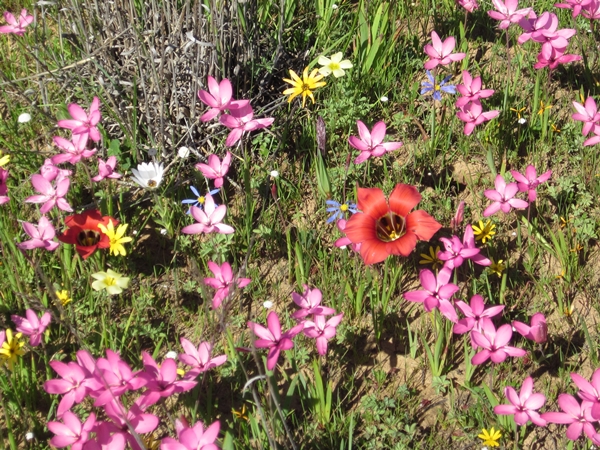
Whizzing by the flower fields in the car is one thing, but stopping to peer into the grass revealed an astounding variety of flowers.


You can see a few yellow bulbinella peeping out above the low growing flora.


I love the red gazanias sprinkled in between the other flowers.


Further on were fields of yellow daisies.


 On the way back to the gate, clouds of pink and purple.


Leaving Matjiesfontein we made a stop off along the dusty road to have a look at the glacial pavement. The tracks scored into the rock were made by boulders trapped under the ice as the glacier slowly inched it's way forward. Hard to imagine this area under glaciers and snow in the last ice age.


We stopped to enjoy the view and a welcome mug of coffee from our flask before descending Vanrhyns Pass, covered in tall yellow daisy bushes, and making our way back to Clanwilliam.  


The irrigation scheme north of Clanwilliam has given rise to a large area under vines and other crops, and it extends for several kilometres along the valley.


The end of a lovely day with the sun on the Cederberg mountains.


This was day one of our little road trip. The next day proved to be just as spectacular. I am still working out how to manage my photos with Windows 10 and a new PC and hope to have more flower photos to show you soon.

Wednesday, September 9, 2015

Sea Silk Weaving

Sea silk is luxury fabric. It is an ultra fine, rare silk that comes from a large clam found off the Mediterranean coast. The silk is very light and warm and if treated with lemon juice turns a bright golden colour that glistens in the sun.

The chasuble of St Yves which is on display in Louannec church -photo credit: ferrebeekeeper
An article about sea silk weaving found in the BBC's online magazine here focuses on one of the last known Italian weavers of this delicate fabric.

There are photos of the clam and its fine byssus thread here on Wikipedia and also on the blog ferrebeekeeper here. Unfortunately the clams which can grow up to one metre are fast disappearing due to pollution and overfishing.

Sunday, September 6, 2015

Cape Embroiderers' Guild Outing

Last Saturday a bus full of happy embroiderers from the Cape Embroiderers' Guild headed up the West Coast to Britannia Bay to visit Leslie-Ann Meek, one of our members. It's flower season here and we saw swathes of pretty white daisies along the roadside as we rode along in the bus. This was the picturesque view awaiting us on our arrival.


A few of the more adventurous took a walk along the beach towards the distant lighthouse - just in time to meet a light shower of rain and hurry back to shelter.


Fresh little lemon flowers dotted the dunes. Aren't they gorgeous?


Back in Leslie-Ann's studio, after a warm welcome of tea and muffins, we were treated to seeing a host of embroidered treasures. Some of you may recognize the Ndebele designs on the Biscornu and needlebook that Leslie-Ann taught a few years ago at the Ighali festival in Fish Hoek.


Below is one of Leslie-Ann's many samplers. It is embroidered with Queen stitch, a stitch extremely popular in the 17th Century. It's a counted thread stitch that is interesting to work and it gives a very distinctive texture that reminds me a little of clusters of crocheted stitches. 


Penny Cornell came well prepared and before lunch organized a short workshop on covering and wrapping tubes and balls


These can be used as embellishments on embroideries. Or they can be dangled to create elaborate tassels.


Leslie-Ann is working on a long term project to cover a wooden box with embroidered panels in the style of 17th century embroidered caskets. She has embroidered several smaller projects to study various techniques in preparation for this big undertaking. 


The white silk pincushion above is embroidered with counted thread stitches. You may wonder how it was possible to do counted thread work on satin. Leslie-Ann explained that she worked over a very fine waste canvas. She commented that it's tricky to use a sharp needle over waste canvas without piercing the canvas threads and then remove the waste threads without damaging the silk fabric or the silk embroidery threads.

Another project that Leslie-Ann is doing to practice the techniques she will use on the casket is covering a mirror-with-doors in stumpwork, typical of the 17th century. The design for the mirror is standing behind the little embroidered box in the photo below.


Laced to it's frame was the beautiful silk and goldwork embroidery destined for covering the mirror. That was until Leslie-Ann discovered with horror that the linen had stretched after the design had been transferred and it is now too big to fit the frame of the mirror! I think we can all sympathize with that awful discovery. Now Leslie-Ann is planning to cut out parts of this embroidery and use them to make traditional Christmas decorations. Then she will start over again by first stretching the linen and only then transferring the design for the mirror project.


Alongside the mirror project, the designs for Leslie-Ann's replica casket are being planned and drawn up. The drawings are then auditioned on a cardboard mock-up of the box which you can see below.


The high point of the afternoon was when Leslie-Ann explained more about the intricacies of the casket project. She carefully unpacked and the wooden box that will eventually be covered with embroidery and showed us how it all fits together.


The box comes apart like a puzzle.


It has lots of little drawers and some very intriguing secret compartments that are cleverly hidden in unexpected places.


Below are the little brass fittings that will trim the box and hold it together. They have been authentically molded and cast from an original 17th century embroidered casket. It was quite fascinating to see the tiny drawer handles and the ornate hinges for the doors that close up the front of the box.


Finally, before boarding the bus for the trip back to Cape Town, we were treated to a scrumptious tea. Who could resist that delicious looking carrot cake and those juicy koeksusters? Twenty one smiling embroiderers agreed that it was a wonderful day and we all left feeling much inspired.


You can find out more about Leslie-Ann's embroidered casket and the related projects on Tricia Wilson Nguyen's outstanding historical embroidery blog The Embroiderer's Story. There are many interesting posts on the the research that Tricia has carried out to source and even manufacture threads and hardware in order to make authentic replica caskets.

For more photos of the CEG outing visit their Facebook page here. Scroll down and click through the photos. There are two lots of photos and plenty to see and read about that lovely day.

Leslie-Ann would love to find another embroiderer in South Africa who is working on a similar casket. Either leave a comment below or email me at lynette[dot]warner[at]gmail[dot]com if you know of someone and I will put you in touch with her. 

Till next time, happy stitching!


Wednesday, September 2, 2015

A Little Progress and How to Centre a Design

I have made a little progress on my Hedebo piece. The weaving in the drawn thread areas has been done and there are photos on my camera. Unfortunately the photos are not yet on my new PC. I am still finding my way around Windows 10 and getting things set up the way I want them. I hope to download all my camera software soon and then I will be able to post some more photos here on my blog. 

In the meantime I can show you the one photo that I do have on my PC of how I marked out the drawn thread areas with pins in order to centre the woven designs in the two leaf shapes. 


Oh, and the little woven motif at the bottom? It was unpicked 5 times before I got it where it was supposed to be! In this photo it's still one square too far to the right.

I hope to show you more photos of the Hedebo progress soon when I should also be able to show you a few photos of the lovely outing I had on Saturday with the Cape Embroiderers' Guild to visit the studio of one of our members.

It's always interesting to learn how other embroiderers approach the small challenges we face in our stitching. If you have any helpful little techniques you would like to share, please either leave a comment below or email me at lynette[dot]warner[at]gmail[dot]com. I'd love to hear from you.

'Till next time, happy stitching!

Thursday, August 20, 2015

Kirstenbosch Botanical Gardens

A bright sunny winter's day took me to Kirstenbosch on a lovely walk through the gardens.


The Kranz Aloes were looking splendid


and the bees were having a feast. There must have been about twenty buzzing around this clump of aloes.


I caught a glimpse of Teddy Bear Mountain along the way. It's a firm favourite among children on school outings and is remembered for years afterwards.  


I was pleased that those dinosaurs in the dinosaur garden were statues and not the real thing. Imagine coming across an animal of that size on your rambles.


I was headed up towards the Treetop Canopy Walk which is well camouflaged until you are right there.


The views of the gardens and surrounding mountains are wonderful.


I saw these flowers from way up on the walkway. They were the most delicate shades of pink.


Not long after my walk, the Hottentot's Holland Mountains off in the distance were tipped with a sprinkling of snow and winter had truly arrived here in Cape Town. The snow doesn't reach very far down the mountains but when it snows the temperature plummets and we know all about it.
  

But on this day the sky was clear and blue.


Making my way back to the car park I crossed the lawns, passed the pond and had a last glimpse of Teddy Bear Mountain. I was already planning my next visit.


Monday, August 17, 2015

Chicken Scratch and Australian Cross Stitch - the Russian Connection

A sudden spike in the number of visitors to my blog had me trying to work out where they all came from. On finding that they were being referred by a Russian website I was even more curious.

It turns out that there is a very good compilation of information together with photos of Chicken Scratch on this Russian website here. If, like me, you don't read Russian, Google Translate will give you a good idea of how the text reads. (The translation is not perfect and you may notice somewhere in the article that the literal translation is "chicken embroidery dash"!)

My gingham pincushions appear at the end of the article as a comparison between Chicken Scratch and Australian Cross Stitch and there is a comprehensive list of resources at the end which includes a direct link to my blog. Many thanks to the author of the article whose name I unfortunately have been unable to confirm.

Australian Cross Stitch pincushions
The difference between Chicken Scratch and Australian Cross Stitch? Although both are stitched on gingham, and both are embroidered with crosses, Australian Cross Stitch never has double cross stitches or running stitch. You can clearly see the double crosses and running stitches so characteristic of Chicken Scratch in the photo below. Find out more in my previous blog post here.

Chicken Scratch 
On the home front, it's real winter here in Cape Town with cold, damp, dismal days. I have been indoors hibernating and getting my new PC up and running the way I want it to. The next step is downloading Windows 10. I will also be teaching an embroidery course on Dresden Lace and Pulled Work soon. A damaged software disk has meant that I can't download my embroidery software for drawing up stitch diagrams. It's going to be a busy week at the keyboard.


Wednesday, August 5, 2015

Hedebo resource

If you are interested in trying some Hedebo embroidery and want a good starting point try visiting the Greve Museum's Hedebo site Hedebosyning here.  Although it is in Danish you can click on the right side of the landing page for the English version.

There is also a free pdf tutorial to follow here. Unfortunately the instructions for the tutorial are in Danish but the stitch diagrams are clear and fairly easy to follow. I'd love to hear from you if you do give it a try. Just leave a comment below.

My computer has been to the 'doctor' again but it is still not fixed. Its unreliable now as it freezes 5 or 6 times a day. Looks like it's on its last legs. I have been putting off making the decision that it is actually quite old and needs replacing. The thought of new software and moving everything over is daunting.

In the meantime, I can borrow a machine to keep in touch and I'll post a longer piece when I can access my files and photos again.

Till then, happy stitching!